
What If You Could Predict - and Even Prevent - Most Business Failures?
Why Do 70%-90% of Business Initiatives Fail?
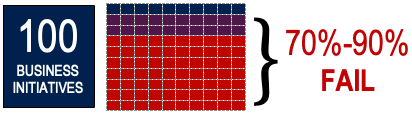
Across industries, studies consistently show that between 70% and 90% of all new products, growth initiatives, transformations, acquisitions, startups, expansions and innovation efforts fail to achieve their objectives.
BUT THEN WHY DO FAILURE RATES REMAIN SO HIGH?

|
Why do failure rates remain high despite years of management innovation, process improvement and execution methodologies? |

|
Why do initiatives fail under both strong and weak leadership? |

|
Why do well-funded initiatives fail at nearly the same rate as all the others? |

|
Why do some organizations thrive, and others fail under the same market conditions? |

|
Why do initiatives fail even when competition is minimal? |

|
Why do so many failures occur in stable markets with mature technologies? |
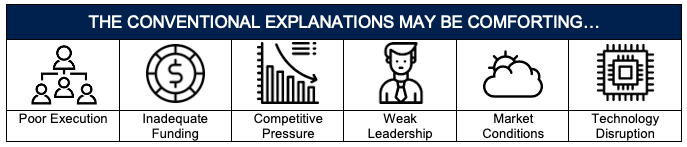
If the conventional explanations were sufficient, failure rates should have fallen long ago.
After decades of research, consulting, and management innovation, and billions of dollars spent improving business performance, why haven't they?
Perhaps we've been trying to solve the wrong problem.
|
71% of PE-funded businesses fail 25% of new business fail in year 1 90% of all start-ups fail by year 5 |
70%-95% of new product launches fail 80% of mergers and acquisitions fail 70% of digital transformations fail |
85% of market expansions fail 95% of digital marketing programs fail 99% of social media programs fail |
After analyzing hundreds of campaigns and initiatives, a different possibility emerged...
What if the traditional explanations describe symptoms rather than causes?
And what if failure begins long before performance declines?
A New Perspective on the Causes and Prevention of Business Initiative Failure
ARCHITECTURAL INTEGRITY - INCREASING THE PROBABILITY OF SUCCESS
A detailed analysis of over 400 business initiatives over 15 years revealed the key:
- Every market opportunity is a structure built on three cornerstones:
• Products
• Prospects
• Needs
Without all three, there's no opportunity. - Business initiatives rarely fail overnight. They evolve as:
• Customers change
• Needs change
• Products evolve
• Strategies expand
• Priorities multiply

Without a deliberate process for maintaining the structural integrity of the initiative, these changes can erode alignment with the initiative's original intent - dramatically increasing the likelihood of failure.
COMMERCIALIZATION DRIFT:
A condition in which an organization gradually loses alignment with the structure of the market opportunity it's attempting to address - significantly increasing the probability of failure.
THE BUSINESS INITIATIVE STUDY: VALIDATING THE MODEL
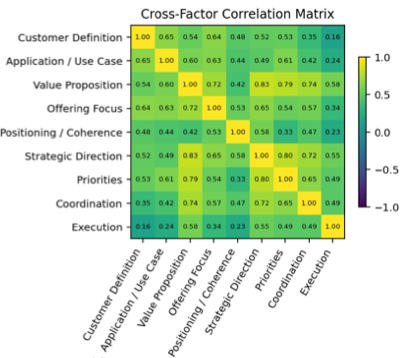
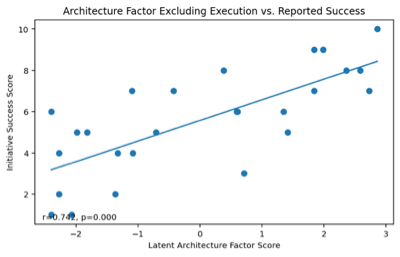
The Business Initiative Study was commissioned to determine whether the cornerstones of the architecture - Customer Definition, Needs, Applications, Value Proposition, Positioning, Offering, Market Coherence and Strategic Direction - are integrated; and whether their structural integrity is correlated with - and predictive of - initiative outcome.
Preliminary Conclusions
- A Market Opportunity behaves as an integrated Architecture
- Architectural integrity is strongly associated with outcome
- Architectural deterioration is visible before performance declines
Learn More
Buy the Book OverviewCommercialization Drift: Why Businesses Fail - and How to Architect Success
Now Available: Executive Briefings • Drift Assessments • Governance and Due Diligence Tools • Workshops